
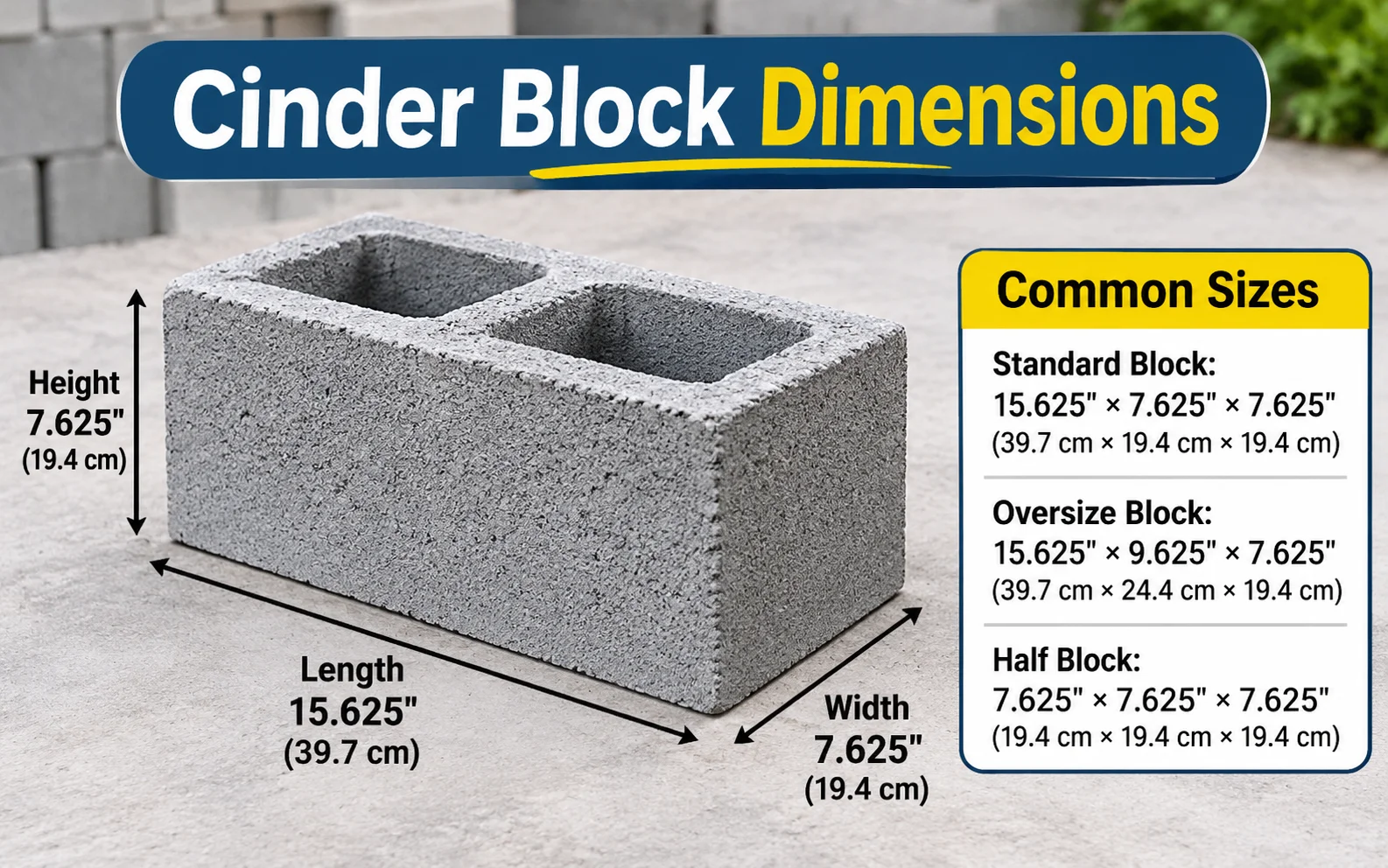
Standard cinder block dimensions are 8 x 8 x 16 inches nominal (height x width x length), and the block you actually hold measures 7-5/8 x 7-5/8 x 15-5/8 inches, because 3/8 inch is saved for the mortar joint.
That one sentence settles most arguments at the hardware store. But if you are about to order a pallet, plan a wall, or squeeze a block into a tight opening, the details matter. A quarter inch here and a missing joint there can turn a neat Saturday project into a pile of cut blocks and a grumpy mood.
So let’s walk through cinder block dimensions the practical way: sizes, inches, centimeters, weight, cores, half blocks, and a simple formula you can copy for your own wall.
What Are Cinder Block Dimensions? (Quick Answer)
Cinder block dimensions are the height, width, and length of a hollow masonry block. Builders list them two ways:
- Nominal size: the rounded number used for planning, such as 8 x 8 x 16 inches. It includes the mortar joint.
- Actual size: the real measurement of the block, usually 3/8 inch smaller in each direction, such as 7-5/8 x 7-5/8 x 15-5/8 inches.
One quick note on terms. True cinder blocks were made with coal cinders and are mostly history. Today’s blocks are concrete masonry units (CMUs) made with cement, sand, gravel, and sometimes lightweight aggregate. Almost everyone still says “cinder block,” so this guide uses that word and means the modern concrete cinder block.
Standard Cinder Block Dimensions Chart (Inches and cm)
Here is the cheat sheet. Save it, screenshot it, tape it inside your toolbox.
| Block Width | Nominal Size (in) | Actual Size (in) | Actual Size (cm) |
Approx. Weight (normal weight) |
|---|---|---|---|---|
|
4 inch |
4 x 8 x 16 | 3-5/8 x 7-5/8 x 15-5/8 | 9.2 x 19.4 x 39.7 |
18 to 26 lb |
|
6 inch |
6 x 8 x 16 | 5-5/8 x 7-5/8 x 15-5/8 | 14.3 x 19.4 x 39.7 |
24 to 34 lb |
|
8 inch |
8 x 8 x 16 | 7-5/8 x 7-5/8 x 15-5/8 | 19.4 x 19.4 x 39.7 | 35 to 43 lb |
| 10 inch | 10 x 8 x 16 | 9-5/8 x 7-5/8 x 15-5/8 | 24.4 x 19.4 x 39.7 |
45 to 55 lb |
|
12 inch |
12 x 8 x 16 | 11-5/8 x 7-5/8 x 15-5/8 | 29.5 x 19.4 x 39.7 |
50 to 65 lb |
Weights are typical ranges for hollow, normal weight units. Lightweight blocks run roughly 20 to 30 percent lighter. Always check the producer’s data sheet for the exact block you buy.
Notice the pattern. Height (7-5/8) and length (15-5/8) stay fixed. Only the width changes. That is why walls of different thickness still line up so nicely.
Standard Cinder Block Dimensions 8x8x16: The Workhorse
If someone says “a cinder block” without any other detail, they mean this one. The standard cinder block dimensions of 8x8x16 are the default for foundations, garages, retaining walls, and fire pits.
Why 8 x 8 x 16? It comes from a simple building module. The block is twice as long as it is tall (16 vs 8). A 16-inch block laid in a running bond overlaps the block below by exactly half, so joints stagger without any cutting. That geometry is why the size has survived for decades.
Standard cinder block dimensions for height are 7-5/8 inches actual, or 8 inches nominal. Standard cinder block dimensions for length are 15-5/8 inches actual, or 16 inches nominal. Three courses stack to 24 inches. Six courses stack to 48 inches. The math is clean.
8 Inch Cinder Block Dimensions and Weight
The 8 inch cinder block dimensions come with a weight that surprises first-timers. A normal weight hollow unit lands around 35 to 43 pounds. A lightweight unit made with expanded shale or slag is closer to 25 to 30 pounds.
Why does it matter? Because 100 blocks is a lot of lifting. At 40 pounds each, that is about two tons of material. Plan your delivery spot, your wheelbarrow, and your back.
Tip: If you are building a garden wall and your helper is not a weightlifter, lightweight units are worth the extra cost per block.
12 Cinder Block Dimensions and Other Widths
People search for 12 cinder block dimensions when they need a thick, strong wall, such as a tall retaining wall or a commercial foundation. A 12-inch block is 11-5/8 inches wide, 7-5/8 inches tall, and 15-5/8 inches long, and it weighs roughly 50 to 65 pounds.
Here is how to choose a width:
- 4 inch: non-loadbearing partitions and veneer backing
- 6 inch: light walls, garden planters, small sheds
- 8 inch: foundations, garages, most loadbearing walls
- 10 and 12 inch: tall retaining walls, commercial structures, extra thick fire walls
Half Cinder Block Dimensions
A half block saves you from cutting. The half cinder block dimensions are 8 x 8 x 8 inches nominal, or 7-5/8 x 7-5/8 x 7-5/8 inches actual. It weighs about half of a full block, so expect roughly 18 to 22 pounds for an 8-inch unit.
You use halves at wall ends and corners to keep the running bond pattern. Without them, every course would end with an awkward stub.
Cinder Block Dimensions Inside: The Cores
People often ask for cinder block dimensions inside because they want to run rebar, conduit, or pour grout into the hollow cores. A standard 8-inch block usually has two large cores, each about 5 to 5-1/2 inches wide in the clear. The exact number depends on the maker.
The outer walls of the block are called face shells. ASTM C90, the main U.S. standard for loadbearing blocks, requires face shells at least 1-1/4 inches thick on an 8-inch unit. The cross walls inside are called webs, and they must be at least 1 inch thick.
Why does this matter for you? Because a #4 rebar fits easily in a core, but a bulky electrical box will not. Check the core size before you plan wiring.
Facts and Benchmarks Worth Knowing
Good planning starts with real numbers. These come from the standards builders and inspectors use:
- ASTM C90 sets the minimum average compressive strength for loadbearing hollow blocks at 2,000 psi, measured on the net area.
- ASTM C90 also defines a “hollow” block as one where the solid area is less than 75 percent of the gross area. Most 8-inch units are far below that, around 50 to 60 percent solid.
- The National Concrete Masonry Association (NCMA) treats a 3/8-inch mortar joint as standard, which is why nominal size equals actual size plus 3/8 inch.
- NCMA coursing tables show that a wall needs about 1.125 blocks per square foot of face area for the 8 x 16 module, or about 112.5 blocks per 100 square feet.
- ASTM C90 requires face shells of at least 1-1/4 inches on 8-inch units, which is why the cores are smaller than the block’s width suggests.
Typical cinder block dimensions across the United States follow the same 8-inch module because of these standards. Outside the U.S., metric blocks such as 190 x 190 x 390 mm are common, so check your local market before you order from an overseas supplier.
Why Nominal vs Actual Matters (Expert Take)
Here is the part most guides skip. The mortar joint is the reason the two sizes exist.
When you lay a block, you add a 3/8-inch bed of mortar. The 7-5/8-inch block plus the 3/8-inch joint equals exactly 8 inches. The 15-5/8-inch block plus the joint equals exactly 16 inches. So the wall behaves like a perfect 8 x 16 grid.
That is why masons plan walls in whole 8-inch courses and 16-inch lengths. If you measure with the actual size, your math will drift. If you measure with nominal size, the mortar fills the gap and everything lands where it should.
Before and After: A Planning Mistake That Costs Money
Before (the mistake): A homeowner wants a wall 6 feet tall. They divide 72 inches by the actual height of 7-5/8 inches and get 9.44 courses. They assume they need 10 courses, and they plan to cut the top row. The wall ends up 6 feet 8 inches tall, or they waste time cutting every block on top.
After (the fix): Use nominal height. 72 divided by 8 equals exactly 9 courses. No cutting, no guessing, no waste.
That tiny change saves about a full course of blocks across the wall’s length and keeps the top flat and tidy.
Mini Case Study: Planning a 10 ft x 4 ft Garden Wall
Here is a worked example you can copy.
- Length: 10 feet = 120 inches. 120 / 16 = 7.5 blocks per course (use 7 full blocks and 1 half block)
- Height: 4 feet = 48 inches. 48 / 8 = 6 courses
- Total: 7.5 x 6 = 45 blocks
- Add waste (10 percent): 45 x 1.1 = about 50 blocks
- Weight check: 50 blocks x 40 lb = roughly 2,000 lb to move
The half block is the hero here. Without it, you would be cutting a full block in half and creating dust and waste.
Author’s note: add a first-hand job-site story here before publishing if you have one. A real anecdote (a corner that did not close, a pallet that arrived short) makes this section even stronger for EEAT.
The N.A.M. Method: A Simple Framework for Block Planning
I use a three-step check that I call N.A.M. (Nominal, Actual, Mortar). It keeps the math honest.
- N: Plan in Nominal. Use 8 x 16 inches for every measurement and layout.
- A: Buy by Actual. Check actual size only for openings, cores, and fit-ups, such as a door frame or a pipe sleeve.
- M: Add the Mortar. Remember the 3/8-inch joint. It is what converts actual size to nominal.
Copy-ready formula:
Blocks needed = (wall length in inches / 16) x (wall height in inches / 8) x 1.10
The 1.10 adds a 10 percent waste buffer for breakage and cuts.
Common Mistakes With Cinder Block Dimensions
- Mixing nominal and actual in one calculation. Pick one system and stay with it.
- Forgetting the mortar joint. A 10-block row is not 156 inches. It is 160 inches nominal.
- Ordering the wrong width. A 6-inch block will not fit a spot designed for 8-inch.
- Ignoring weight. Heavy units slow the job, strain your back, and can overload a trailer.
- Skipping half blocks. Cutting is slower and creates uneven ends.
- Assuming every maker is identical. Cores, weights, and finishes vary by plant.
Your Quick Checklist Before You Order
- Decide the wall width (4, 6, 8, 10, or 12 inch)
- Measure the wall in inches, then use the N.A.M. formula
- Add 10 percent for waste
- Order half blocks for ends and corners
- Confirm weight and plan how to move the blocks
- Check ASTM C90 on the supplier’s data sheet for loadbearing walls
- Verify local code before you build
Key Takeaways
- Standard cinder block dimensions are 8 x 8 x 16 inches nominal and 7-5/8 x 7-5/8 x 15-5/8 inches actual.
- The 3/8-inch mortar joint explains the gap between nominal and actual.
- Height and length stay constant. Only the width changes (4, 6, 8, 10, 12 inches).
- An 8-inch block weighs roughly 35 to 43 pounds. Lightweight units are lighter.
- Plan with nominal size and use about 1.125 blocks per square foot.
- Half blocks measure 8 x 8 x 8 inches nominal and save you from cutting.
Conclusion
Cinder block dimensions are easier than they look once you know the nominal vs actual trick. Remember 8 x 8 x 16 for planning, 7-5/8 x 7-5/8 x 15-5/8 for the real block, and 3/8 inch for the joint. Use the N.A.M. method, add 10 percent for waste, and double-check weight and local code before you start. Do that, and your next wall will be square, strong, and refreshingly boring to build.
FAQs About Cinder Block Dimensions
What are cinder block dimensions?
Cinder block dimensions are the height, width, and length of a hollow concrete block. The standard is 8 x 8 x 16 inches nominal, or 7-5/8 x 7-5/8 x 15-5/8 inches actual.
What are the standard cinder block dimensions in inches?
The standard cinder block dimensions in inches are 7-5/8 high, 7-5/8 wide, and 15-5/8 long for the common 8-inch block. In centimeters, that is about 19.4 x 19.4 x 39.7 cm.
What are 8 inch cinder block dimensions and weight?
An 8-inch block is 7-5/8 x 7-5/8 x 15-5/8 inches and weighs about 35 to 43 pounds in normal weight concrete. Lightweight versions run about 25 to 30 pounds.
Are cinder block dimensions the same as concrete block dimensions?
Yes, for modern blocks. People use “cinder block” and “concrete block” for the same product today, and both follow the 8 x 8 x 16 module. Older true cinder blocks are rare and may differ.
What are half cinder block dimensions?
The half cinder block dimensions are 8 x 8 x 8 inches nominal, or 7-5/8 x 7-5/8 x 7-5/8 inches actual. Masons use them at wall ends to keep the running bond pattern.
