
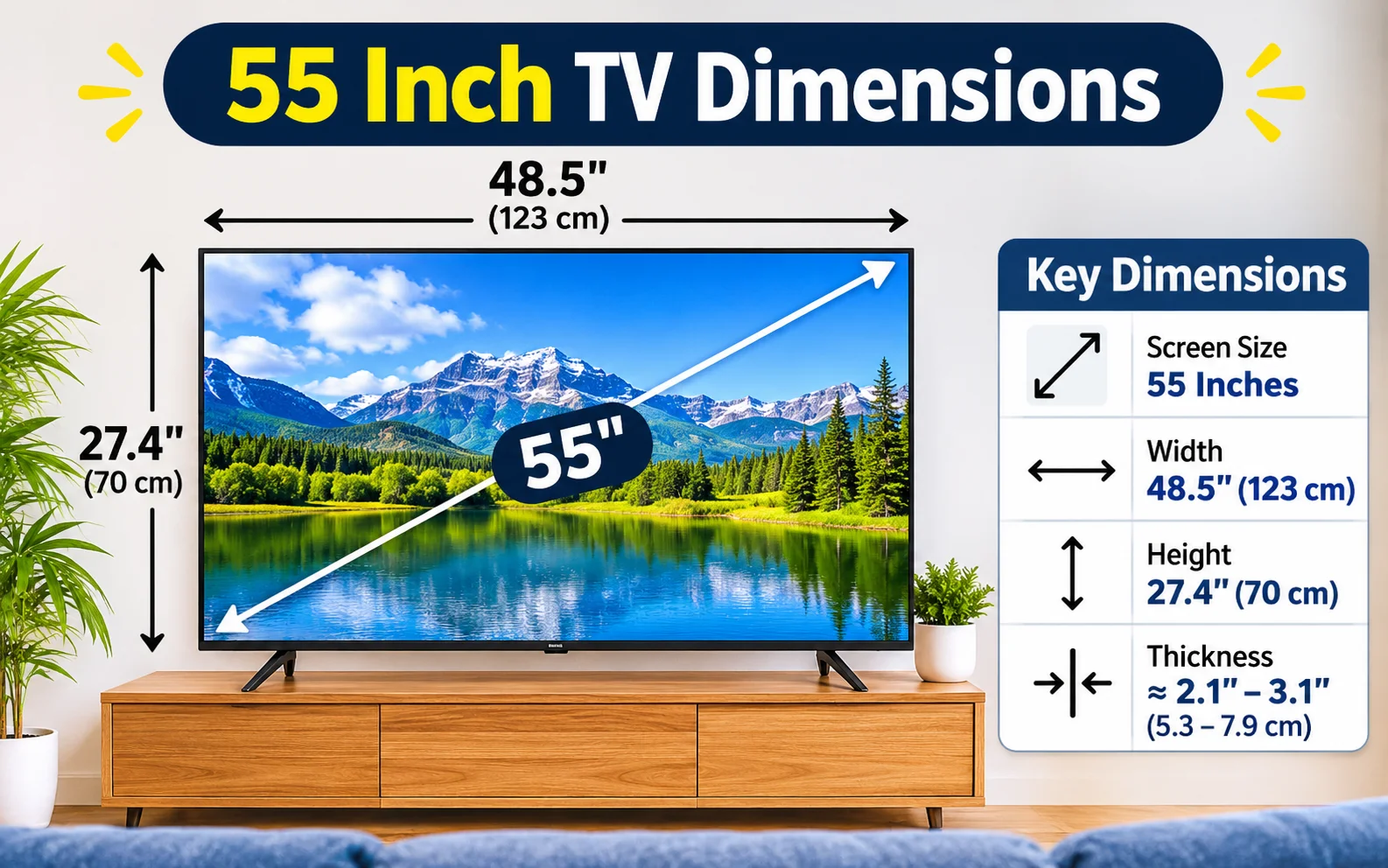
A 55 inch TV is about 48 inches wide and 27 inches tall (122 x 69 cm), and most 2026 models are only 1 to 3 inches deep without the stand. That is the short answer. The long answer is where you save yourself a return trip to the store. The “55” on the box measures the screen diagonally, so it tells you almost nothing about whether the TV will fit your shelf, wall or console. These 55 inch TV dimensions, checked against 2026 spec sheets from six major brands, give you the real numbers in inches, centimeters and feet.
Quick Answer: 55 Inch TV Dimensions at a Glance
Here is the screen size of a standard 16:9 TV, calculated from the diagonal. Add roughly half an inch of bezel on each side for the full TV body.
| Measurement | Inches | Centimeters | Feet |
|---|---|---|---|
|
Diagonal |
55 in | 139.7 cm |
4.58 ft |
|
Width (screen only) |
47.9 in | 121.8 cm | 3.99 ft |
| Height (screen only) | 27.0 in | 68.5 cm |
2.25 ft |
|
Typical full TV width |
48.1 to 48.7 in | 122 to 124 cm | about 4.0 ft |
| Typical depth, no stand | 1 to 3 in | 2.5 to 7.6 cm |
under 0.25 ft |
That covers 55 Inch TV Dimensions in Inches, in cm and in feet. In plain words: a 55 inch TV is almost exactly 4 feet wide and a little over 2 feet tall.
55 Inch TV Dimensions Width and Height: The 16:9 Math
Every modern TV uses a 16:9 shape. That ratio is why you can work out the width and height of any screen with two tiny multipliers.
The formula:
- Width = diagonal x 0.8716
- Height = diagonal x 0.4903
For 55 inches: 55 x 0.8716 = 47.9 inches wide, and 55 x 0.4903 = 27.0 inches tall. This is the 55 Inch TV Dimensions Width Height 16:9 calculation in one line. To get centimeters, multiply any inch figure by 2.54. So 47.9 in becomes 121.7 cm, and 27.0 in becomes 68.6 cm.
Why does this work? A 16:9 screen forms a right triangle with its diagonal. The diagonal is always 1.0, the width is 0.8716 of it, and the height is 0.4903 of it. Once you trust that triangle, you can check any brand’s claim in ten seconds.
55 Inch TV Dimensions Diagram
This is the 55 Inch TV Dimensions Diagram in text form. Bookmark it, or sketch it on the back of an envelope before you measure your wall.
          <---- 47.9 in (121.8 cm) ---->
     +--------------------------------------+  ^
     |                                      |  |
     |          55-inch screen (16:9)       |  27.0 in
     |                                      |  (68.5 cm)
     +--------------------------------------+  v
             diagonal = 55 in (139.7 cm)
55 Inch TV Dimensions Length and Width
People search for 55 Inch TV Dimensions Length and Width a lot. For a TV, “length” simply means the horizontal side, which is the width. There is no separate length. If a listing says 48 x 28 inches, the 48 is the width and the 28 is the height.
Why the Real TV Is Slightly Wider Than the Screen
The protective frame, called the bezel, adds a little to each side. Retailers list a “55 inch class” TV with an actual diagonal near 54.6 inches, according to Best Buy and LG spec listings. So the numbers you see on a product page run a touch above the pure math.
55 Inch TV Dimensions Width Height Depth: With and Without a Stand
This is the table most buyers actually need. The stand changes the 55 Inch TV Dimensions Width Height Depth more than anything else, especially depth. All figures below come from 2026 retailer spec sheets, converted to inches.
|
2026 model (55 in) |
Width | Height, no stand | Depth, no stand | Height, with stand |
Depth, with stand |
|---|---|---|---|---|---|
|
Samsung The Frame Pro |
48.7 | 28.1 | 1.0 | 30.3 |
8.2 |
|
Samsung S90H OLED |
48.2 | 27.9 | 1.6 | 30.5 |
10.4 |
|
LG OLED evo C6 |
48.1 | 27.7 | 1.8 | 29.8 |
9.1 |
|
Sony Bravia 7 II |
48.4 | 27.8 | 2.3 | 30.9 |
8.3 |
|
TCL QM7L |
48.3 | 28.0 | 2.2 | 29.9 |
10.6 |
|
Hisense U7 |
48.3 | 28.1 | 2.3 | 30.6 |
10.4 |
|
Roku Select (55R5D5) |
48.3 | 27.9 | 2.9 | not listed |
12.7 |
Notice the pattern. Width barely moves, from 48.1 to 48.7 inches. Depth and stand design are where TVs differ.
Brand by Brand: Samsung, LG, Sony, TCL, Hisense and Roku
Every brand follows the same 16:9 math. What changes is the cabinet and the stand. Here is what matters for each.
Samsung 55 Inch TV Dimensions
Samsung 55 inch TV dimensions run about 48.2 to 48.7 inches wide. The S90H OLED measures 1,225 mm wide and 708.6 mm tall without a stand, per The Good Guys listing. The Frame Pro is the widest of the group at 48.7 inches and wall-hugging at about 1 inch deep. Samsung also lists a recommended viewing distance of 170 cm for its 2026 55 inch models.
LG 55 Inch TV Dimensions
LG 55 inch TV dimensions for the C6 OLED are 48.1 x 27.7 x 1.8 inches without the stand, or 122.2 x 70.3 x 4.5 cm. With the stand it grows to 29.8 inches tall and 9.1 inches deep, according to LG retailer listings. The stand is 18.5 inches wide.
Sony 55 Inch TV Dimensions
Sony 55 inch TV dimensions for the Bravia 7 II are 48.4 x 27.8 x 2.3 inches, per PC Richard’s spec sheet. The Bravia 3 II is a touch shorter and thicker at 1,225 x 717 x 70 mm. Sony’s stand is narrow, only 13.6 inches wide on the Bravia 7 II.
TCL 55 Inch TV Dimensions
TCL 55 inch TV dimensions for the QM7L are 48.3 inches wide and 28 inches tall without the stand, per Best Buy. It has a centered stand that is just 12.4 inches wide, which makes it friendly to small consoles.
Hisense 55 Inch TV Dimensions
Hisense 55 inch TV dimensions for the U7 are 1,227 x 714 x 58 mm without the stand. That equals 48.3 x 28.1 x 2.3 inches. Add the stand and you get 30.6 inches of height and 10.4 inches of depth.
Roku 55 Inch TV Dimensions
Roku 55 inch TV dimensions for the 2026 Select Series QLED are 48.3 inches wide and 27.9 inches tall. It is about 2.9 inches deep, and the stand reaches 12.7 inches front to back, per Best Buy. It is also the lightest in this group at 20.1 pounds without the stand.
50 Inch vs 55 Inch TV Dimensions
Shoppers often search 55 Inch TV Dimensions because they are stuck between two sizes. The gap is smaller than you think.
| Size | Width | Height | Screen area |
|---|---|---|---|
| 50 inch | 43.6 in (110.7 cm) | 24.5 in (62.3 cm) | 1,068 sq in |
| 55 inch | 47.9 in (121.8 cm) | 27.0 in (68.5 cm) | 1,293 sq in |
| Difference | +4.3 in | +2.5 in | +21% |
A 55 inch screen is about 21% bigger by area, yet it is only 4.3 inches wider. If your space has room for 50, it often has room for 55. Measure first, because that extra 4.3 inches is exactly what breaks tight alcoves.
Data Points Worth Knowing
These numbers change how you should shop.
- Width is nearly identical across brands. The 2026 models above span 48.1 to 48.7 inches, a spread of 0.6 inches (retailer spec sheets from Best Buy, PC Richard and The Good Guys).
- Depth varies almost threefold. Samsung’s Frame Pro is 1 inch deep, while the Roku Select is 2.9 inches (Best Buy and PC Richard).
- Stand width is the real wildcard. It runs from 12.4 inches on the TCL QM7L to 35.5 inches on the Samsung Frame Pro (Best Buy and PC Richard).
- Weight differs a lot. The LG C6 weighs 31.1 pounds without its stand (HDTV Magazine), against 20.1 pounds for the Roku Select (Best Buy). That matters for wall mounts.
- Viewing distance follows the diagonal. THX suggests about 1.2 times the diagonal, which is roughly 5.5 feet for a 55 inch screen. SMPTE’s wider guidance of about 1.6 times gives roughly 7.3 feet.
A stand adds about 2 to 3 inches of height in the table above. Smart Home Starter’s Hisense guide puts the range at 2 to 4 inches, so budget the higher number.
The 3-Gap Fit Check: A Framework You Can Copy
I use this framework whenever a friend asks “will it fit?” It takes five minutes and has never failed me. The reason it works: TVs fail at the gaps, not at the screen size.
Gap 1: Width gap. Take your furniture width and subtract the TV width from the table above. Add the stand footprint check. If the TV has two outer feet, the feet spread must fit on the surface, not the TV width.
Gap 2: Height gap. Measure from the surface to the shelf, soundbar or ceiling above. Use the with stand height, then add 2 inches of breathing room for heat and cables.
Gap 3: Depth gap. Measure the surface depth. Compare it to the with stand depth. Add 3 to 4 inches behind the TV for cables.
Your Copy-and-Paste Workflow
- Write down the width, height and depth of your space in inches.
- Pick your model and find its dimensions with stand (or without, if wall mounting).
- Subtract the TV from the space on all three axes.
- If any result is under 2 inches, move to a smaller stand or a wall mount.
- Check the wall mount pattern (VESA) and weight rating before ordering.
Mini Case Study: The 34-Inch Console
Here is a scenario I see again and again. Someone owns a slim console that is 34 inches wide. They assume a 55 inch TV is too big and consider shrinking to 43 inches. That is the before.
Here is the after. The screen overhangs the console by about 7 inches on each side, which is fine because the TV does not need to sit inside the console. What matters is the stand. A Samsung Frame Pro needs 35.5 inches for its feet, so it fails on a 34-inch surface. A TCL QM7L needs only 12.4 inches, so it sits comfortably in the middle.
The lesson: stand design beat screen size. They kept the 55 inch screen and skipped a downgrade they never needed.
Common Mistakes When Using 55 Inch TV Dimensions
- Measuring the diagonal and treating it as the width. The width is 48 inches, not 55.
- Ignoring the stand footprint. Feet spread often matters more than the TV itself.
- Forgetting depth with the stand. Some stands reach 12.7 inches front to back.
- Using the box size. Packaging runs about 53 to 55 inches wide, so it is larger than the TV. Measure doorways and stairs too.
- Skipping cable space. Leave 3 to 4 inches behind a wall-mounted or shelf TV.
- Trusting old guides. 2026 models are thinner and some have narrower stands. Always check the current spec sheet.
Is 55 Inches the Right Size for Your Room?
For most living rooms, yes. At the THX distance of about 5.5 feet, a 55 inch TV fills your view without making you turn your head. Sit farther back, say 8 feet or more, and a 65 inch set starts to make more sense. The 55 inch TV dimensions also suit bedrooms and apartments where wall space is tight.
Conclusion
The 55 inch TV dimensions are simple once you drop the diagonal: about 48 inches wide, 27 inches tall, and 1 to 3 inches deep before the stand. Measure your space, run the 3-Gap Fit Check, and compare the stand footprint before you click buy. Do that and the size on the box will never surprise you again.
Key Takeaways
- A 55 inch TV is about 48 x 27 inches (122 x 69 cm), or roughly 4 x 2.25 feet.
- Use width = diagonal x 0.8716 and height = diagonal x 0.4903 for any 16:9 screen.
- Width barely changes by brand, but stand width ranges from 12.4 to 35.5 inches.
- Always check the with-stand height and depth, not just the screen size.
- A 55 inch screen is only 4.3 inches wider than a 50 inch, yet 21% larger.
FAQs About 55 Inch TV Dimensions
What are the 55 inch TV dimensions in cm, and how many feet is that?
The 55 inch TV dimensions in cm are about 122 cm wide and 69 cm tall for the screen, or 122 to 124 cm wide for the full TV. In feet, that is roughly 4 feet wide and 2.25 feet tall.
What are the 55 inch TV dimensions width, height and depth with a stand?
With a stand, most 2026 models are about 48 inches wide, 29.8 to 30.9 inches tall and 8 to 13 inches deep. Without the stand, depth drops to 1 to 3 inches and height to about 28 inches.
Do Samsung, LG, Sony, TCL, Hisense and Roku 55 inch TV dimensions differ?
Not by much in width, which stays between 48.1 and 48.7 inches. They differ more in depth, stand width and weight, so compare those on the spec sheet before buying.
What is the difference between 50 inch and 55 inch TV dimensions?
A 55 inch TV is 4.3 inches wider and 2.5 inches taller than a 50 inch. That gives about 21% more screen area for a small increase in footprint.
Why don’t my 55 inch TV dimensions length and width equal 55 inches?
Because 55 inches is the diagonal, not a side. On a 16:9 TV the width is 47.9 inches and the height is 27 inches, plus a small bezel.
